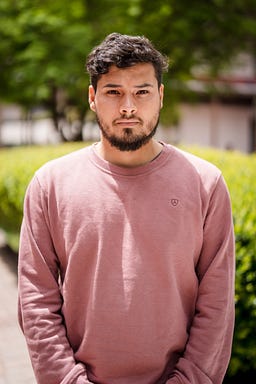
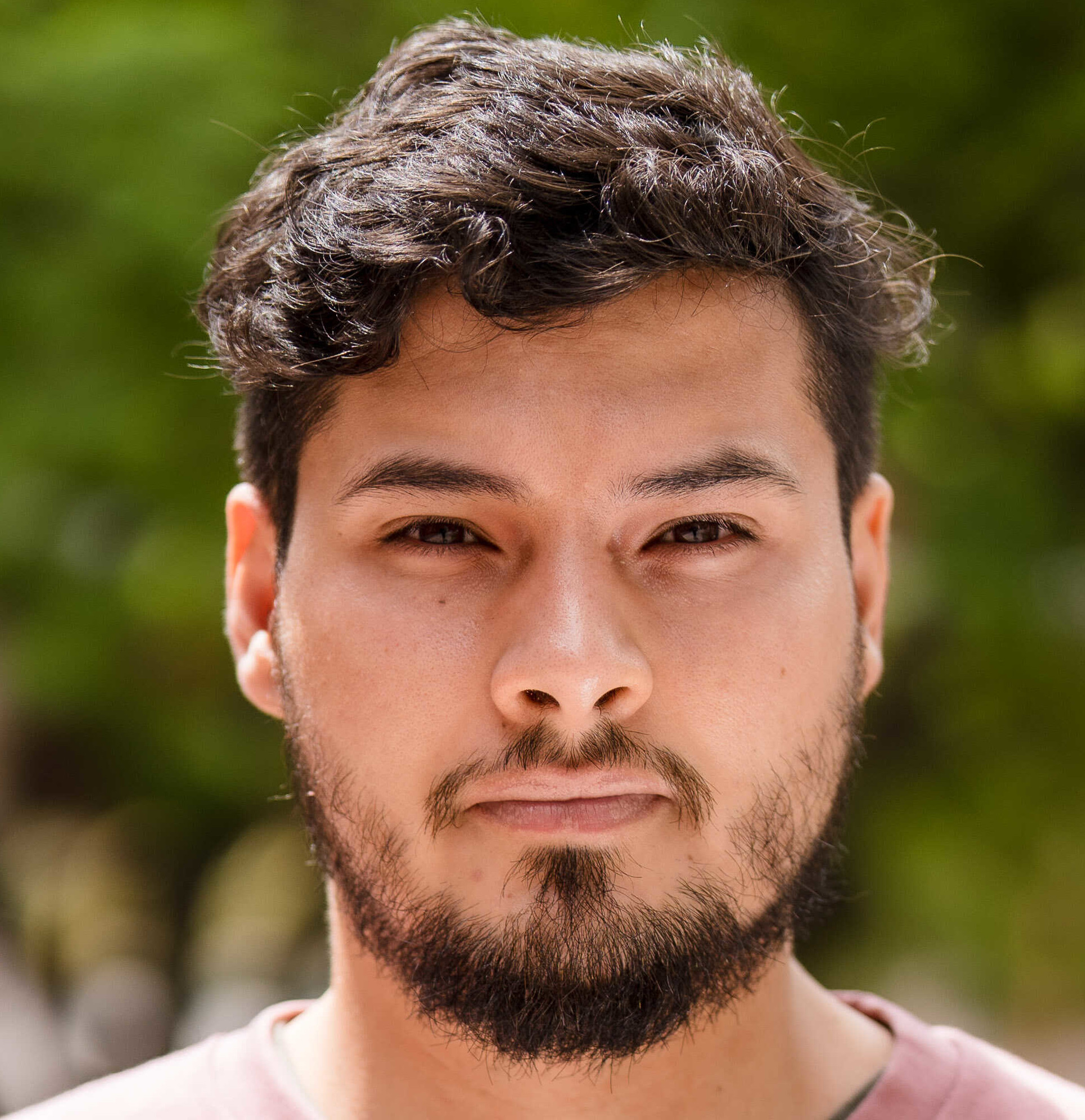


ABOUT ME

I AM MIGUEL CÁRCAMO

Miguel Cárcamo - Computer Engineer and Radio Astronomer
  • Full Name

    Miguel Cárcamo, Prof.
  • Position

    Assistant Professor, Departamento de Ingeniería Informática, Universidad de Santiago de Chile
  • Address

    Av. Víctor Jara 3659 (ex Av. Ecuador), Estación Central, Chile
  • Phone

    (+56) 2 2718 0940
  • Email

    miguel.carcamo@usach.cl

I am an Assistant Professor at the Universidad de Santiago de Chile and an Associate Researcher at the Data Observatory. I hold a Ph.D. in Astronomy and Astrophysics from the University of Manchester (2019-2023), where I developed novel compressed sensing frameworks for Faraday depth reconstruction. My research program encompasses radio interferometry and advanced imaging techniques, cosmic magnetism, high-performance computing, and large-scale data processing for astronomical applications. I am the principal developer of Pyralysis, a Python object-oriented framework designed for big data processing and high-performance computing applications targeting SKA-era data volumes. My work emphasizes end-to-end computational workflows for radio astronomical data, developing software systems that handle the complete processing chain from raw observations through to calibrated, imaged, and validated scientific datasets.

Explore research areas

I am an Assistant Professor at the Universidad de Santiago de Chile and an Associate Researcher at the Data Observatory. I hold a Ph.D. in Astronomy and Astrophysics from the University of Manchester (2019-2023), where I developed novel compressed sensing frameworks for Faraday depth reconstruction. My research program encompasses radio interferometry and advanced imaging techniques, cosmic magnetism, high-performance computing, and large-scale data processing for astronomical applications. I am the principal developer of Pyralysis, a Python object-oriented framework designed for big data processing and high-performance computing applications targeting SKA-era data volumes. My work emphasizes end-to-end computational workflows for radio astronomical data, developing software systems that handle the complete processing chain from raw observations through to calibrated, imaged, and validated scientific datasets.

Explore research areas

SELECTED CONTRIBUTIONS

  • Multi-GPU maximum entropy image synthesis for radio astronomy: Early work on high-performance computational imaging for interferometric data. View paper.
  • CS-ROMER: a novel compressed sensing framework for Faraday depth reconstruction: 1D Faraday Tomography using compressed sensing for next-generation telescopes. View paper.
  • Variable structure in the PDS 70 disc and uncertainties in radio-interferometric image restoration: Study connecting source variability and imaging systematics in disc observations. View paper.
  • Hourly radio variability of PDS70c from time-differential photometry: Forthcoming A&A Letters on short-timescale variability in circumplanetary radio emission. View paper.

MISCELLANEOUS

  • Currently I am a master's swimmer and part of Ñuñoa Master Club.
  • I enjoy building LEGO sets in my free time.
  • I like reading suspense and thriller novels, and also books on psychology and neuroscience.
  • I am a registered member and supporter of Colo-Colo.
  • I enjoy listening to music.
  • I enjoy watching movies and TV series.
  • I like both video and board games.

my skills

my special expertise

EDUCATION

  • 2019 - 2023

    Ph.D. in Astronomy and Astrophysics

    The University of Manchester, UK. Supervisor: Prof. Anna Scaife. Thesis: "Compressive Faraday Imaging for Next-Generation Radio Telescopes." Developed novel compressed sensing frameworks for Faraday depth reconstruction.

    Ph.D. thesis (PDF) (opens in new tab)

  • 2015 - 2016

    M.Sc. in Computer Engineering

    Universidad de Santiago de Chile. Supervisor: Prof. Fernando Rannou. Thesis: "Interferometric image synthesis through parallel iterative algorithms on multiple GPUs."

    M.Sc. thesis (USACH repository) (opens in new tab)

  • 2010 - 2016

    Civil Computer Engineer

    Universidad de Santiago de Chile. Comprehensive training in computer science, software engineering, and computational methods.

  • 2010 - 2013

    B.Sc. in Engineering Sciences

    Universidad de Santiago de Chile. Foundation in engineering principles and mathematical methods.

work EXPERIENCE

  • 2023 - Present

    Assistant Professor

    Universidad de Santiago de Chile. Teaching courses in Operating Systems, Distributed and Parallel Systems, Software Development, and Radio Interferometry. Principal developer of Pyralysis framework for SKA-era data processing.

  • 2022 - Present

    Associate Researcher

    Data Observatory. Research in high-performance computing and large-scale data processing for astronomical applications.

  • 2019 - 2022

    Part-time Instructor Professor

    Universidad de Santiago de Chile. Taught courses in Operating Systems, Software Engineering, and Programming Methods while completing Ph.D. research.

my skills

my special expertise

Python Programming

0%
95% Complete

Radio Interferometry

0%
92% Complete

Compressed Sensing

0%
90% Complete

CUDA & Parallel Computing

0%
90% Complete

C/C++ Programming

0%
88% Complete

Faraday Depth Reconstruction

0%
92% Complete

ONGOING PROJECTS

Open source research software

Pyralysis, CS-ROMER, and GPUVMEM are the main open-source projects from my group. Additional tools are listed on the software page.

Pyralysis

PYthon Radio Astronomy anaLYSis and Image Synthesis

CS-ROMER

Compressed sensing for Faraday depth reconstruction

GPUVMEM

GPU-accelerated maximum entropy imaging

RESEARCH SOFTWARE

Open source tools for radio astronomy and scientific computing

Featured projects

Additional tools

SNOW

caSa pythoN self-calibratiOn frameWork

Python framework for radio astronomy self-calibration workflows with a unified interface to imagers and calibration algorithms.

Repository

OCARINA

Interferometric data processing utilities

Tools and utilities for radio interferometric data processing, analysis, and image synthesis.

Repository

RESEARCH

SCIENTIFIC FOCUS AREAS

My research connects radio astronomy, computational imaging, and high-performance computing. Use the tabs below to explore each focus area — methods, science goals, and selected publications.

The topic

Magnetic fields are everywhere in space, even where we cannot see them directly. Earth’s field turns a compass needle; the Sun’s field drives flares and the solar wind; on larger scales, galaxies and the gas between them are threaded by fields that influence how stars form and how energy is transported.

The open questions are ambitious: how strong are those fields, how are they arranged across the Milky Way and beyond, and do they help or hold back the birth of stars? Polarised radio light is one of our best witnesses—light that has been nudged by magnetised gas along the way, leaving a trace we can decode. With the SKA, that trace will be readable on a scale we have never had before.

What I do

I develop methods to recover magnetic-field structure from polarised radio data, using techniques such as Faraday tomography and modern computing so that large surveys remain practical. The goal is reliable, reproducible tools that scientists can use on SKA-era data volumes.

Community. Associate member of the SKAO Magnetism Science Working Group (Universidad de Santiago de Chile).

Selected publications

PUBLICATIONS

Research articles and conference proceedings (auto-synced from NASA ADS)

Last synchronized from NASA ADS: 2026-06-25T20:59:58Z

PUBLICATION STATISTICS

Scholarly metrics from NASA ADS

Total Papers i

21

Total Citations i

406

h-index i

10

m-index i

0.8333

Lead-author Papers i

7

First-author Papers i

4

FONDECYT NP i

4.4846

Citation Velocity (5y) i

3.4722

Open Access Share i

80.95%

Leadership Citation Ratio i

0.654

International Collaboration Share i

80.95%

Recent Momentum (5y) i

46.34

Flagship Impact Share i

65.76%

In the last 5 years, recent work contributes 30.79% of total citation impact.

Methodology (Transparency)

Metric definitions and formulas
  • total_publications = journal papers + conference papers.
  • lead_author_publications = papers with author position 1 or 2.
  • h-index: largest h such that at least h papers have >= h citations.
  • i10-index: number of papers with >= 10 citations.
  • m-index = h-index / years_since_first_publication.
  • average_citations_per_paper = total_citations / total_publications.
  • median_citations_per_paper: median citation count across all included papers.
  • citation_velocity.citations_per_effective_year uses papers from the last 5 years and computes sum(citations) / sum(max(1, current_year - publication_year)).
  • open_access_share_percent is computed from ADS property flags.
  • collaboration.avg_coauthors_per_paper uses distinct co-authors per paper, excluding Miguel.
  • country_collaboration.* is inferred from affiliation text and should be interpreted as collaboration geography, not nationality.
  • leadership.leadership_impact_ratio compares citations per paper in lead roles (author position 1-2) vs supporting roles.
  • momentum.momentum_score = average of 5-year paper share and 5-year citation share (0-100 scale).
  • impact_concentration.top5_citation_share_percent reports how much total citation impact is concentrated in top-5 papers.

FONDECYT-style NP (ANID GE Astronomía y Astrofísica):

  • Use journal papers from current_year - 5 up to current_year (inclusive).
  • For each paper, c_i = citations / max(1, current_year - pub_year).
  • Leadership factor l_i by author position: 1-2: 1.00, 3: 0.90, 4: 0.70, 5: 0.50, 6: 0.30, 7+: 0.20.
  • s_i = l_i * sqrt(1 + c_i).
  • Take top 10 papers by s_i.
  • P = sum(s_i) over top 10.
  • NP = min(1.0 + 1.7 * P^0.25, 5.0).

Papers per Year

Annual and Cumulative Citations

Citation Distribution

Top 10 Most Cited Papers

Top Collaborators (by shared papers)

Collaboration Network

Filter network

Top coauthors by shared papers. Node size reflects collaboration frequency. Hover or click for details — Miguel is at the center.

Collaboration Map (Inferred Affiliation Countries)

Country is inferred from affiliation text in ADS metadata, not author nationality.

FONDECYT NP Top-10 Contributors

TEACHING

Courses and academic instruction

Current Courses

Universidad de Santiago de Chile (USACH) - Assistant Professor

  • Distributed and Parallel Systems (1/2026) - Designed and taught
    Contents: Concurrent and parallel programming, Architectures, Communication, Coordination, Consistency and replication, Fault tolerance.

Previous Courses

Universidad de Santiago de Chile (USACH) - Assistant Professor

  • Operating Systems (1/2024 – 2/2025)
    Contents: Processes, Threads, Concurrency, Deadlock, Scheduling and Virtual Memory.
  • Radio Interferometry and Image Synthesis in Astronomy (2/2023 – 2/2025) - Designed and taught
    Contents: Radio interferometry principles, Mathematical Groundwork for radio astronomy, Advanced Python for radio astronomy, Positional astronomy, Visibility space, Image Synthesis, Image synthesis deconvolution, Observing systems, Data reduction and errors.
  • Software Development (1/2024)
    Contents: Python, Functional programming, Object Oriented programming, numpy, cupy, dask, Scrum and Extreme Programming, Software versioning, git, Continuous integration and pipelines, Python packaging.
  • Distributed Systems (2/2023)
    Contents: Architectures, Communication, Coordination, Consistency and replication, Fault tolerance.
  • Software Engineering Project (1/2023 – 2/2023)
    Contents: Scrum Methodology, Software testing, Continuous Integration, Deployment.
  • Operating Systems (1/2023)
    Contents: Processes, Threads, Concurrency, Deadlock, Scheduling and Virtual Memory.

Universidad de Santiago de Chile (USACH) - Part-time Instructor Professor

  • Operating Systems (2/2015 – 2/2018)
    Contents: Processes, Threads, Concurrency, Deadlock, Scheduling, Virtual Memory and I/O.
  • Programming Methods Laboratory (1/2018 – 2/2018)
    Contents: Algorithmic Problem Solving, Imperative Programming, Problem Solving in C, Imperative Programming Paradigm in C.
  • Modeling and Simulation (2/2016) - Designed and taught
    Contents: Continuous Systems, Queue Theory, Pseudo-Random Numbers, Markov Chain Monte Carlo and Discrete Events.

The University of Manchester - Laboratory Demonstrator

  • Introduction to Programming for Physicists (1/2023, 1/2022, 1/2020)
  • Object-Oriented Programming in C++ (2/2022)
  • Theory Computing Project (2/2020)

LaTeX templates (USACH)

COLLABORATORS & PARTNERS

Research institutions and key collaborators

Key Collaborators

  • Prof. Anna Scaife
    The University of Manchester
  • Prof. Fernando Rannou
    Universidad de Santiago de Chile
  • Prof. Pablo Román
    Universidad de Santiago de Chile
  • Prof. Simon Casassus
    Universidad de Chile

Collaborating Institutions & Facilities

  • e-MERLIN
    UK's National Radio Telescope Interferometer. Enhanced Multi Element Remotely Linked Interferometer Network headquartered at Jodrell Bank Observatory, operated by the University of Manchester.
  • IDIA
    Inter-University Institute for Data Intensive Astronomy. Partnership supporting MeerKAT large survey science and SKA pathfinder telescope projects.
  • Universidad de Santiago de Chile (USACH)
  • Data Observatory
  • Millennium Nucleus YEMS (Young Exoplanets and their MoonS)
  • The University of Manchester - Interferometry Center of Excellence (ICE)

STUDENT SUPERVISION

Current and former students

Current Students

Master Students

  • Renato Gomez
  • Estefanía Álvarez

Undergraduate Students

  • Javiera Jorquera
  • Maximiliano Ahumada
  • Nicolás Gajardo
  • Esteban Arenas
  • Yuyunisse Carreño

Co-supervised Students

Current Co-supervised Students

  • Ricardo Hasbún

Former Co-supervised Students

JOIN THE GROUP

Research opportunities for students at USACH

I supervise PhD, master's, and undergraduate students at the Universidad de Santiago de Chile (Departamento de Ingeniería Informática) on projects in radio astronomy, scientific computing, and data-intensive research. If you are curious about interferometry, cosmic magnetism, planet-forming discs, or building research software, read on.

Funded projects accepting students

DICYT Regular 2026 · USACH

Principal Investigator

Pyralysis: Desentrañando los Campos Magnéticos del Cosmos con Big Data y Supercómputo

  • Cosmic magnetism
  • Radio interferometric imaging
  • High-performance computing

FONDECYT Regular 2025

Co-Principal Investigator

Physical conditions and kinematics in planet-forming systems

  • Planet formation & discs
  • Radio interferometric imaging

Open positions

PhD research — radio astronomy & scientific computing

Open

Doctoral topics tied to funded projects: large-scale interferometric imaging, compressed sensing for polarimetry, cosmic magnetism, GPU/HPC pipelines, and open research software (Pyralysis). Co-supervision with astronomy or physics programmes is possible depending on the topic and degree requirements.

  • PhD

Master's thesis — radio astronomy & scientific computing

Open

Topics include interferometric imaging, GPU computing, compressed sensing for polarimetric data, and contributions to the Pyralysis framework. Suitable for students in computer engineering, astronomy, physics, or related fields with strong programming skills.

  • Master's
  • Undergraduate

Undergraduate research assistantships

Open

Short- and medium-term projects for DIINF students: software development, data pipelines, algorithm prototyping, and validation on radio astronomy datasets. Prior coursework in Python and algorithms is expected.

  • Undergraduate

Example project ideas

Concrete topics vary — these illustrate the kind of work we do.

Pyralysis pipelines for SKA-era polarimetry

Build and benchmark high-performance processing workflows for large radio surveys, with emphasis on reproducibility and GPU acceleration.

  • Radio interferometric imaging
  • High-performance computing
Related software Pyralysis
  • PhD
  • Master's
  • Undergraduate

Compressed sensing for Faraday tomography

Extend and validate CS-ROMER on survey-scale polarimetric data; compare reconstruction quality and uncertainty quantification against classical methods.

  • Compressed sensing
  • Cosmic magnetism
Related software CS-ROMER
  • PhD
  • Master's

GPU-accelerated interferometric imaging

Prototype and profile imaging algorithms (MEM, convex optimisation) on multi-GPU systems for realistic array configurations.

  • Radio interferometric imaging
  • High-performance computing
Related software GPUVMEM
  • PhD
  • Master's
  • Undergraduate

Disc structure and variability in radio interferometry

Co-supervised projects connected to planet-forming systems: imaging systematics, variability, and linking observations to physical models. In collaboration with Prof. Simon Casassus.

  • Planet formation & discs
  • Radio interferometric imaging
  • PhD
  • Master's

What helps

  • Python programming Expected
  • Comfortable with Linux / command line Expected
  • Linear algebra & basic numerical methods Expected
  • Genuine interest in astronomy or signal processing Expected
  • CUDA / GPU computing (nice to have) Plus
  • Version control (git) and reproducible workflows Plus

Contribute through Pyralysis issues

Open work items on GitLab are a good way to find a scoped project — pick an issue that matches your skills and mention it when you get in touch.

Browse Pyralysis work items

How to apply

  1. Explore the research areas

    Read the research pages and software hub to see which topics fit your background and interests.

  2. Pick a Pyralysis issue (optional)

    Many thesis and RA projects start from a concrete task. Browse the Pyralysis work items on GitLab, find an open issue that fits your level, and tell me which one you'd like to work on.

  3. Send an introductory email

    Include a short CV, transcript (or GPA summary), relevant coursework, and a brief statement (½ page) on why the project interests you and what you hope to learn. If you picked a Pyralysis issue, mention it in the email.

  4. Meet to discuss fit

    We schedule a conversation (in person or online) to align expectations, timeline, and supervision arrangements with USACH degree requirements.

services

academic service and recognition

Scientific focus areas — cosmic magnetism, planet formation & discs, radio interferometric imaging, and compressed sensing — are described on the Research page, with methods, community affiliations, and selected publications for each theme.

ACADEMIC HIGHLIGHTS

funding, invitations, service, and awards

Funded Projects

  • Principal Investigator (PI) - DICYT Regular 2026, Universidad de Santiago de Chile. Project: Pyralysis: Desentrañando los Campos Magnéticos del Cosmos con Big Data y Supercómputo.
  • Co-Principal Investigator (co-PI) - FONDECYT Regular 2025. Project: Physical conditions and kinematics in planet-forming systems.

Academic Service

Invitations, Talks, and Posters

  • 2024 - Invited lecturer, 1st FARGO3D Workshop (Radio Interferometry and Radio Interferometric Synthetic Observations).
  • 2023 - Invited participant, Isaac Newton Institute multidisciplinary programme: Rich and Nonlinear Tomography.
  • 2022 - Talk at URSI AT-RASC, Gran Canaria: A Compressed Sensing Faraday Depth Reconstruction Framework for the MeerKAT MIGHTEE-POL Survey.
  • 2021 - Talk at National Astronomy Meeting (University of Bath): High-throughput computing for Cosmic Magnetism studies in the SKA-era.
  • 2023 - Poster at BASP Frontiers conference, Villars-sur-Ollon: The importance of compressed sensing and regularization: An application to Faraday depth imaging.

Awards & Honors

  • 2022 - Young Scientist Award, URSI Atlantic Radio Science Conference. Program | Awarded paper
  • 2019 - 2023 - Chilean National Scholarship for Graduate Studies (ANID).

THE FAINT SIGNAL

Essays on radio astronomy, computing, and everything in between

Astronomer and computer engineer at USACH. I spend my days looking for faint signals in radio data, and most of what I write here is an attempt to do the same with everything else.

Latest posts

Has Communism Ever Actually Failed?

Has Communism Ever Actually Failed?

June 21, 2026

Since my PhD years in Manchester and the 2022 Chilean presidential elections (maybe before that, I think), I have been receiving the same sort of arguments. The USSR collapsed. Cuba is poor. Venezuela is a disaster. North Korea is a nightmare. Therefore, communism is dictatorial

El problema de la señal: democracia, ruido y Chile como laboratorio

El problema de la señal: democracia, ruido y Chile como laboratorio

June 11, 2026

Hay una pregunta que Platón hizo hace 2.400 años y que nadie ha respondido satisfactoriamente: si para cruzar el mar en una tormenta necesitas un capitán que sepa navegar, ¿por qué para gobernar un país basta con que la mayoría levante la mano? Es una pregunta incómoda. Y hay un

On observing oneself

On observing oneself

May 27, 2026

A few recent conversations have me thinking about an old idea that sounds banal but is rarely applied. A discipline you teach quietly stops being yours the moment you stop operating it. The shift is invisible from the inside, because the vocabulary keeps working, the concepts kee

LET'S TALK

Get in touch with me

Please feel free to get in touch anytime, whether for work inquiries or to just say hello.

  • ADDRESS

    Av. Víctor Jara 3659, Departamento de Ingeniería Informática, Office 203

  • CONTACT INFO

    miguel.carcamo@usach.cl
    (+56) 2 2718 0940

  • WORKING HOURS

    Daily 9am to 17pm (Not available on weekends)